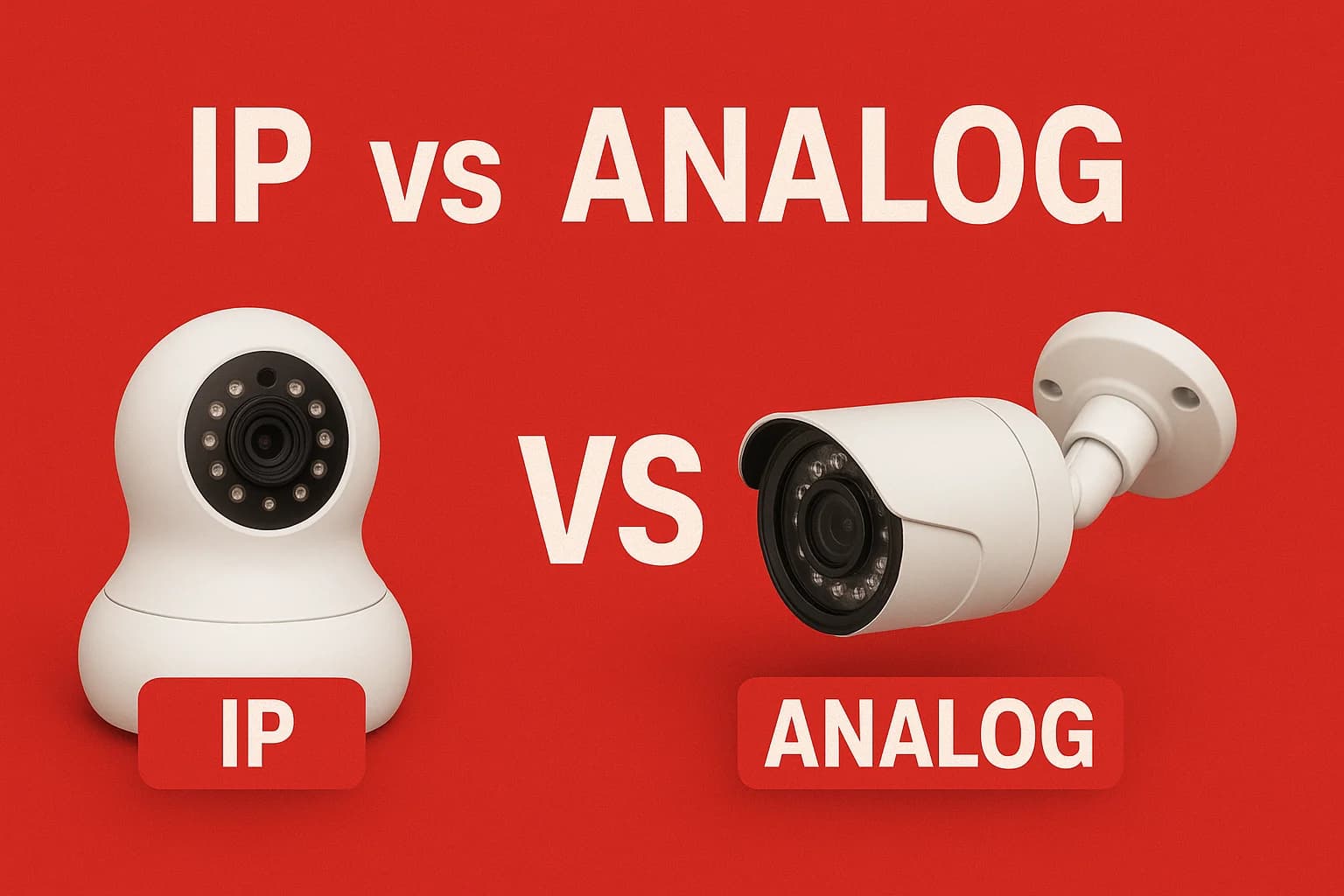
If you are buying CCTV in 2026, the first real decision is not the brand — it is the technology. IP camera vs analog camera is the choice that shapes your image quality, your cabling, your costs, and how easily you can expand later. Both are still sold, both still work, and contrary to a lot of online noise, analog is not "dead." The honest answer to "which is better" is: it depends on your site, your budget, and how long you plan to keep the system.
This guide compares the two neutrally for Indian buyers — covering resolution, the coax-versus-Cat6 cabling reality, real costs, smart features, and one timely point most guides miss: the STQC 2026 certification rule that treats IP and analog cameras very differently. By the end you will know which one fits your home, shop, office, or large site.
In a hurry? Skip to which should you choose by use case — or read the full comparison first.
IP vs Analog: The Head-to-Head Table
Here is the short version. Details and exceptions follow below.
| Factor | IP Camera (NVR) | Analog / HD Camera (DVR) |
|---|---|---|
| Max resolution | 2MP to 12MP+ (true 4K common) | 2MP to 8MP (HD-TVI/CVI/AHD); 4K rare |
| Recorder | NVR or cloud | DVR (local only) |
| Cabling | One Cat6 cable, power + data (PoE) | Coax (RG59/RG6) + separate power |
| Max cable run | ~90–100m per run (extendable) | ~300m+ on coax |
| Smart / AI features | Built-in (person, vehicle, face, line-cross) | Limited; basic analytics on some DVRs |
| Remote access | Native app, easy | Possible, needs more setup |
| Scalability | Add any ONVIF camera; very flexible | Locked to DVR channels and format |
| Reliability if internet drops | Records locally on NVR; viewing affected | Records on DVR; fully offline-capable |
| Upfront cost | Higher | Lower |
| STQC 2026 scope | In scope — must be STQC-certified | Pure analog falls outside IoT scope |
| Best for | Detail, growth, 5+ year systems | Tight budgets, retrofits, offline sites |
No single column "wins" every row, which is exactly why both technologies still exist.
What Each One Actually Is (Plain English)
IP cameras
An IP (Internet Protocol) camera is a small networked computer with a lens. It captures video digitally, compresses it (usually H.265), and sends it as data over a network cable to a Network Video Recorder (NVR) or the cloud. With Power over Ethernet (PoE), a single Cat6 cable carries both power and video, so one run per camera does everything.
Because the camera itself has a processor, the intelligence lives on the camera: person/vehicle detection, face and line-crossing alerts, and analytics all run on the device. Most modern IP cameras also follow the ONVIF standard, so a Hikvision, Dahua, CP Plus, Uniview or Reolink camera can generally work with another brand's ONVIF NVR — useful for mixing and matching later.
Analog cameras (and what "HD analog" really means)
A traditional analog camera sends a raw video signal over coaxial cable to a Digital Video Recorder (DVR), which digitises and stores it. The old CVBS analog topped out around 960H (sub-1MP) — that is the blurry footage analog earned its bad reputation for.
Here is the nuance most comparison guides skip: today's "analog" is almost always HD-over-coax — HD-TVI (Hikvision), HD-CVI (Dahua) or AHD (generic). These send 2MP, 4MP and even 8MP HD video over the same coax cable. So when people say "analog is low quality," they are usually describing 15-year-old CVBS, not a modern 4MP HD-TVI camera, which produces genuinely sharp footage. The catch: HD-over-coax cameras are usually locked to a matching DVR format, and 4K on coax is rare and expensive.
Image Quality: The Real Differences
On a clean install in good light, a 4MP HD-TVI analog camera and a 4MP IP camera look surprisingly close. The gaps show up in harder conditions:
- Resolution ceiling — IP goes well past 8MP (true 4K and beyond) and stays affordable there. Modern analog reaches 8MP but it is uncommon, so for license-plate or face identification at distance, IP has the headroom.
- Wide Dynamic Range (WDR) — IP cameras generally handle backlit scenes (a shop entrance against bright daylight, a glass door) better, so faces are not lost in glare.
- Signal integrity — IP video is digital end-to-end, so there is no quality loss over the cable run. Analog signals can degrade or pick up electrical interference over long coax runs.
- Digital zoom — More IP pixels means you can zoom into recorded footage and still read detail; low-resolution footage falls apart when enlarged.
For a deeper look at brands and sensor quality, see our best CCTV camera brands in India for 2026.
Cabling and Installation: Where Sites Actually Differ
This is the factor installers care about most, because it decides labour and feasibility.
IP / PoE uses one Cat6 cable per camera for both power and data into a PoE NVR or switch — clean, fewer points of failure, and easy to add cameras. The limit is roughly 90–100m per cable run before you need a switch or extender.
Analog / coax uses RG59/RG6 coax for video plus a separate power line (or power-over-coax). The big advantage: coax runs comfortably past 300m, which suits long perimeters, farms, and large warehouses without extra network gear. It is also a natural fit when a building already has coax in the walls.
The decision often comes down to existing wiring: a new build leans IP; a retrofit with good coax already in place often leans HD analog. (If you are also weighing wired versus wireless, our WiFi vs wired CCTV guide covers that trade-off.)
Cost: Honest Expectations
Analog is cheaper upfront — both the cameras and the DVR cost less than the IP equivalent, which is why budget projects still pick it. IP costs more per camera and needs a PoE NVR/switch, but tends to win on total cost over 5+ years: lower maintenance, free firmware feature updates, and easier expansion instead of forklift replacements.
We avoid quoting hard prices here because they move with brand, resolution and channel count. For current Chennai figures, see our transparent CCTV installation cost and price list.
Smart Features and Scalability
This is where IP clearly pulls ahead. Because the camera has a processor, AI features run on the device: accurate person and vehicle detection, face and number-plate capture, line-crossing and intrusion zones, people counting and heat-mapping. These cut false alarms dramatically versus motion detection that fires on every passing shadow. Analog DVRs offer only basic, less accurate analytics.
On scalability, IP adds cameras as easily as running another cable to the switch, and ONVIF lets you mix brands on one NVR. Analog is capped by the DVR's channel count and locked to its format, so a bigger system often means a new DVR. For systems you plan to grow, IP is the future-proof path — and our complete guide to CCTV installation in Chennai walks through planning a system end to end.
The India 2026 Angle: STQC Changes the Math
This is the point that genuinely separates the two technologies in India today, and most global guides ignore it.
Under India's STQC / IoT System Certification Scheme, certification is fundamentally about cybersecurity — default passwords, signed firmware, encrypted transport, chipset transparency and resistance to attack. Because IP cameras connect to a network, they fall squarely inside this scope. As of the April 2026 deadline, selling or deploying a non-compliant IP camera in India carries real legal and financial risk, so buying an IP camera now effectively means buying an STQC-certified model.
Pure analog cameras connect only to a DVR over coax — not to a network — so they sit largely outside the IoT cybersecurity scope. That can look like a loophole, but read it the right way: if you go IP, insist on certified hardware; if you go analog for a closed, offline circuit, you are choosing a different risk profile, not dodging the rule. We explain the full picture in our STQC certification guide for CCTV in India 2026. Every IP system WAEI installs is STQC-compliant by default.
Which Should You Choose? By Use Case
Home (4–8 cameras). For a new home where you want phone alerts, clear faces at the gate, and room to add a camera or two, IP is the better long-term pick. On a tight budget or replacing an old analog set with coax already run, a modern 4MP HD-TVI analog system is a sensible, sharp, lower-cost choice.
Shop / small retail. IP at the entrance and billing counter pays off — face capture and reliable person detection deter and document theft. Mixing in analog for back aisles via a hybrid recorder keeps costs down.
Office / commercial. Go IP. You will likely want remote multi-site viewing, integration with access control and alarms, and analytics like people counting — all native to IP.
Large site / factory / warehouse / farm. This is the one case where analog still shines: coax handles 300m+ runs cheaply across a big perimeter without network switches everywhere. Many large sites run a sensible hybrid — IP for critical zones (gates, cash, server rooms), HD analog for broad general coverage — on a recorder that supports both.
The hybrid and upgrade path
You rarely have to pick one and rip out the other. Hybrid (XVR) recorders accept both IP and HD-over-coax cameras on one interface, so you can put IP where detail matters and analog where it does not. If you already run analog on healthy coax, you can often upgrade to HD-TVI/CVI on the same cables, then add IP cameras for priority areas and migrate gradually over a couple of years — no need to rewire the building at once.
Our Recommendation for 2026
For most new installations, we recommend IP cameras: the price gap has narrowed, the image quality and AI features are worth it, expansion is painless, and STQC-certified IP hardware is the cleaner compliance story. Choose modern HD analog when budget is the hard constraint, when you are reusing good coax, or when long cable runs across a big site make coax the practical choice — and prefer HD-TVI/CVI at 4MP+, not old CVBS. When in doubt, a hybrid lets you have both.
Whatever you choose, WAEI Enterprise can help you get it right. With 500+ projects across Chennai, a free site survey, 1 year of free AMC, and STQC-compliant installations, we will design a system that fits your site and budget — not just sell you the most expensive option. Explore our IP CCTV and analog CCTV services, ask about an annual maintenance plan, or book your free consultation.
Frequently Asked Questions
Is an IP camera better than an analog camera?
For most new installations, yes — IP cameras offer higher resolution, built-in AI detection, easier remote access, and simpler expansion. But analog (especially modern HD-TVI/CVI) is still the better fit for tight budgets, very long cable runs, or sites that reuse existing coax, so "better" really depends on your needs.
What is the main difference between IP and analog cameras?
An IP camera sends digital video as data over a network cable (Cat6) to an NVR or the cloud, while an analog camera sends a video signal over coaxial cable to a DVR. That difference drives everything else — resolution ceiling, cabling, smart features, scalability, and even certification rules.
Is HD-TVI the same as an IP camera?
No. HD-TVI is modern HD-over-coax and belongs to the analog family — it sends HD video over coax to a TVI DVR. An IP camera is networked, uses Ethernet, and connects to an NVR. HD-TVI gives you HD quality on coax cabling, but not IP features like native ONVIF interoperability or on-camera AI.
Do IP cameras require an internet connection?
No. IP cameras need a local network to reach the NVR, but they record locally without any internet. You only need internet to view footage remotely on your phone. Analog systems also record offline; remote viewing simply requires extra setup.
Are analog cameras covered by STQC certification in India?
IP and network-connected cameras fall inside India's STQC / IoT certification scope because it focuses on cybersecurity, so in 2026 your IP camera should be STQC-certified. Pure analog cameras connect only to a DVR over coax, not a network, so they currently sit largely outside that scope. Always confirm the latest rules before buying.
Can I mix IP and analog cameras in one system?
Yes. A hybrid (XVR) recorder supports both IP and HD-over-coax cameras on a single interface. This lets you use IP cameras for critical areas like entrances and billing counters while keeping cheaper analog cameras for general coverage, and it makes gradual upgrades from analog to IP much easier.
Last updated: June 2026. Specifications and certification rules are subject to change — confirm current requirements before purchase.
Tags
- IP Camera
- Analog Camera
- CCTV Comparison
- Security Cameras Chennai
- NVR vs DVR
- HD-TVI Camera