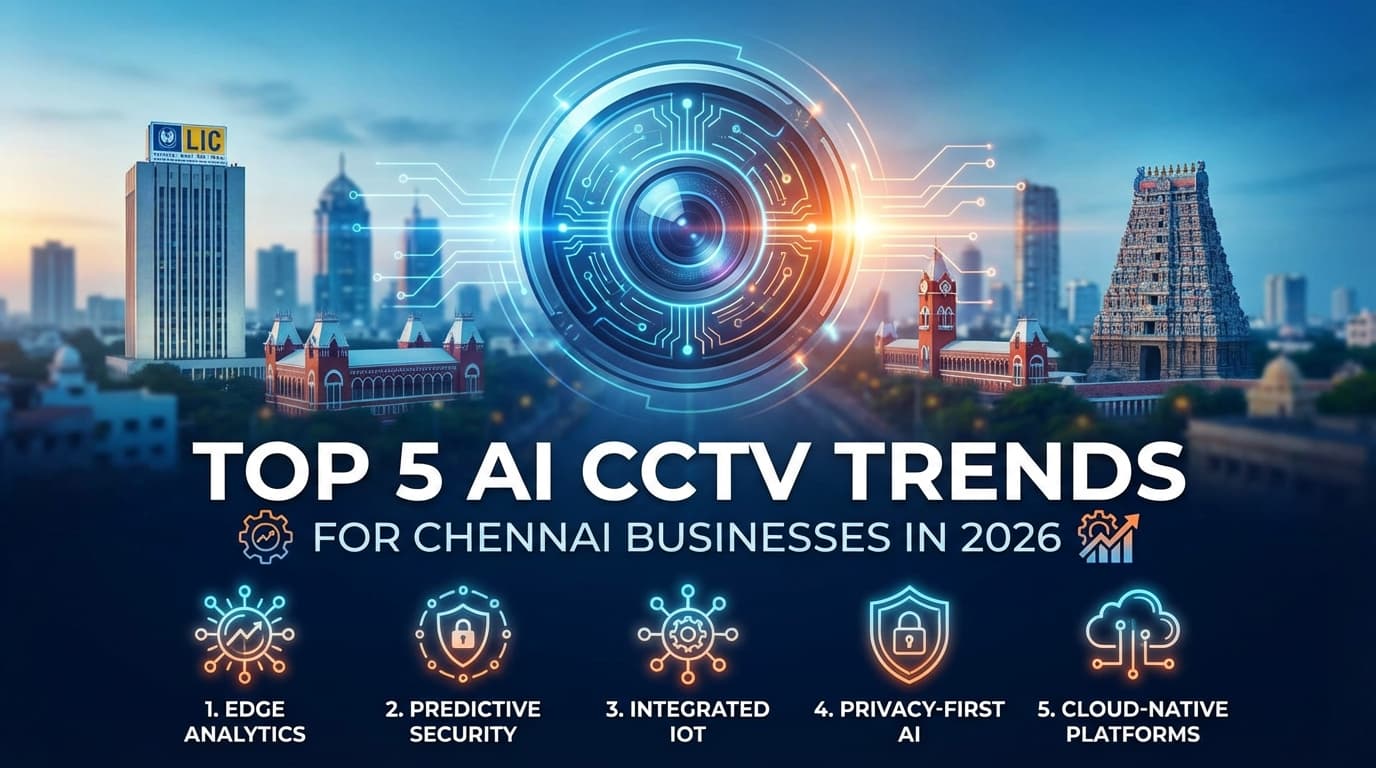
For most Chennai businesses, CCTV has always been a system you check after something goes wrong. That is changing fast. In 2026, AI CCTV cameras in India can detect an intrusion, count footfall, read a number plate, or flag a worker without a helmet the moment it happens — and send an alert before a guard has even noticed. The India CCTV market is projected to grow from roughly USD 5 billion in 2025 toward USD 22.5 billion by 2034, and AI analytics is the single biggest reason.
This is not vague hype. Below are the five AI CCTV trends 2026 that actually matter for a retailer in T. Nagar, a warehouse in Redhills, or an IT office in OMR — each tied to real use cases, real ROI, and the new STQC rules that now govern every networked camera sold in India.
Planning an upgrade? Book a free site assessment with WAEI Enterprise's Chennai-based security team.
1. Edge AI: Analytics That Run Inside the Camera
The biggest shift in AI surveillance for business is where the thinking happens. Traditional setups send every frame to a central server or the cloud for analysis. Edge AI cameras run the analytics on a built-in neural processor (typically 4–8 TOPS) inside the camera itself, detecting people, vehicles, and events in under 100 milliseconds.
For Chennai businesses, the practical wins are concrete:
- Bandwidth savings of 70–90% — only events and metadata travel the network, not raw 24/7 video. This matters when an Ambattur or Guindy unit runs on a modest broadband line.
- It keeps working during outages — detection continues even when the internet drops.
- Several analytics on one camera — intrusion, ANPR, and people counting can run simultaneously without a separate appliance.
- Lower storage and server cost — smart recording captures relevant events instead of continuous footage.
Edge AI is also why modern alerts are trustworthy. The camera uses context — time of day, zone, and movement pattern — rather than dumb motion, which leads directly to the next trend.
Ready for edge AI cameras? Our IP CCTV installation services deploy edge-analytics cameras suited to Chennai networks.
2. Smart Video Analytics: Six Use Cases With Real ROI
This is the heart of smart CCTV analytics Chennai businesses are adopting. Generic "motion detection" is being replaced by purpose-built analytics that map to measurable outcomes. The six with the clearest payback:
| Analytic | What it does | Chennai use case & ROI |
|---|---|---|
| Intrusion / line-crossing | Flags entry into a defined zone after hours | A perimeter breach alert at a Redhills warehouse before goods leave the gate — cuts shrinkage |
| People counting | Counts and tracks footfall | A T. Nagar retailer optimising staffing and store layout from real footfall data |
| ANPR (number plate) | Reads vehicle plates at gates | Automated entry and visitor logs at a Siruseri IT park or gated facility |
| PPE / safety detection | Flags missing helmets, vests | A Sriperumbudur factory catching safety violations before an accident or audit |
| Heat mapping | Shows where people dwell | A mall or showroom finding dead zones and high-engagement aisles |
| Loitering / object-left-behind | Detects suspicious dwell or abandoned items | A bank branch or Ranganathan Street store flagging unusual behaviour |
The ROI is rarely just "fewer thefts." For factories and warehouses, PPE and intrusion analytics reduce both losses and insurance and audit risk — a theme we go deeper on in our guide to CCTV for factories and warehouses in Chennai. For retail, the same cameras double as a footfall and conversion tool. You are paying for security and getting operational data for free.
3. False-Alarm Reduction: Why Operators Finally Trust the Alerts
Ask any Chennai security supervisor what kills a CCTV system and the answer is alert fatigue — swaying trees, stray dogs, rain, monsoon shadows, and insects near the lens triggering hundreds of useless notifications until everyone ignores them.
AI changes the economics. Modern analytics reliably distinguish a human or vehicle from environmental noise, and vendors commonly report 85–95% reductions in nuisance alarms. For a business, that has a direct ROI:
- Guards and managers respond only to events that matter, so genuine incidents are not missed in the noise.
- One person can monitor more sites — useful for a retail chain across Anna Nagar, Velachery, and Adyar.
- Remote monitoring becomes viable, because alerts are credible enough to act on without a person watching screens all day.
False-alarm reduction is the least glamorous trend on this list and arguably the one with the fastest payback.
4. The 2026 STQC Mandate: Every AI/IP Camera Is Now Regulated
This is the trend Chennai business owners cannot ignore, because it is law, not a feature. From 1 April 2026, it is illegal to sell, supply, or install network-connected cameras in India that do not carry BIS and STQC certification. STQC (Standardisation Testing and Quality Certification) is a directorate under MeitY, and the Essential Requirements (ER) order covers exactly the cameras this article is about: IP cameras, PoE cameras, NVR-based and cloud-connected systems — in other words, every AI camera.
What this means in practice for a Chennai business:
- New installs must use certified models. Non-compliant gear can attract penalties of up to 10x product value and, in serious cases, imprisonment for sellers.
- Your existing cameras keep working — the rule is not retroactive. But if a unit fails, you cannot replace it with the same non-compliant model.
- Sourcing has shifted. Several Chinese brands are not yet certified, and STQC-compliant Indian manufacturers now dominate the market. Choosing the right brand matters more than ever — see our best CCTV camera brands in India for 2026.
The takeaway: any AI CCTV upgrade you plan this year should start from the STQC-certified list, not from whatever was cheapest last year. We break the rules down fully in our STQC certification CCTV India 2026 complete guide.
5. AI Search and Privacy-by-Design
Two newer trends are reshaping how businesses use footage and defend it.
Natural-language and AI-assisted search. Instead of scrubbing hours of video, operators increasingly search footage by description — "show vehicles at the back gate after 10 PM" or "person in a red shirt near the entrance." Edge cameras already tag events as structured metadata, which makes investigations that once took an afternoon take minutes. For a multi-location Chennai business, that is fewer hours lost to incident review.
Privacy-by-design. As facial recognition and behaviour analytics become common, so does scrutiny. India's Digital Personal Data Protection framework, signage requirements, and sensible data-retention limits are now part of any responsible deployment. Practical steps that keep you compliant and credible:
- Display visible CCTV notices wherever cameras record.
- Set retention to what your industry actually needs, not "keep everything forever."
- Restrict who can access footage and analytics, and log that access.
Privacy is not a tax on AI surveillance — done early, it is a selling point with customers and a shield in any dispute.
How Chennai Businesses Should Approach an AI CCTV Upgrade
You do not need every trend on day one. A sensible sequence:
- Map your actual risks. A warehouse needs intrusion and PPE analytics; a showroom needs footfall and heat mapping. Buy for your use case, not the brochure.
- Check your network. Edge AI is forgiving, but you still want enough bandwidth and a reliable NVR. A site survey settles this.
- Insist on STQC-certified, IP-based cameras. This is now non-negotiable for new installs.
- Plan storage and retention around compliance and how far back you realistically investigate.
- Budget for upkeep. AI cameras need firmware updates and tuning; an annual maintenance contract keeps analytics accurate and uptime high.
For a ground-up view of doing this well in the city, our complete guide to CCTV installation in Chennai walks through placement, camera mix, and infrastructure.
Why Chennai Businesses Choose WAEI Enterprise
As Chennai's trusted security partner since 2015, WAEI Enterprise brings:
- 500+ successful installations across Chennai
- 5000+ cameras deployed in homes and businesses
- 24/7 technical support with local response teams
- Transparent pricing and STQC-compliant camera options
- Free on-site demonstrations so you see AI analytics working before you buy
Frequently Asked Questions
What are the top AI CCTV trends in 2026?
The leading AI CCTV trends in 2026 are edge AI cameras that run analytics on the device, smart video analytics for intrusion, people counting, ANPR, PPE and heat mapping, dramatic false-alarm reduction, the new STQC certification mandate for all networked cameras in India, and privacy-by-design with AI-assisted footage search. Together they move CCTV from passive recording to proactive, useful intelligence.
Are AI CCTV cameras worth it for a small business in Chennai?
Yes, for most small and medium businesses the payback is fast. The same cameras reduce theft and false alarms while doubling as a footfall, safety, and operations tool, so you get security and business data from one investment. The right scope depends on your premises and risks, which a free site assessment can pin down.
What is the STQC mandate and does it affect my CCTV?
From 1 April 2026, all network-connected cameras sold or installed in India — IP, PoE, NVR-based, and cloud cameras — must carry BIS and STQC certification. Any new AI CCTV you install must use certified models. Your existing cameras can keep running, but failed units cannot be replaced with non-compliant models.
How do AI cameras reduce false alarms?
AI cameras use context such as object type, time of day, zone, and movement pattern to tell a real person or vehicle apart from rain, shadows, swaying trees, or animals. This typically cuts nuisance alarms by 85–95%, so staff respond only to genuine events and real incidents are not lost in the noise.
Can AI CCTV integrate with my existing system in Chennai?
Often yes. AI-enabled NVRs and edge cameras can frequently work alongside existing IP infrastructure, though older analog setups may need upgrades to gain full analytics. A WAEI site assessment evaluates your current cameras, network, and storage and recommends the most cost-effective path.
Is AI surveillance legal in India?
Yes, when deployed responsibly. Businesses should display visible CCTV signage, follow India's data protection guidelines, set sensible retention periods, and restrict access to footage and analytics. With these practices in place, AI surveillance including analytics is fully legal for commercial use.
Ready to Upgrade to AI CCTV?
The AI CCTV trends of 2026 are not about flashier cameras — they are about turning surveillance into something your Chennai business actually acts on, while staying on the right side of the new STQC rules. Whether you run a store in Mylapore, a factory in SIPCOT, or an office in Taramani, the time to plan is now.
Tags
- AI CCTV
- Chennai Business Security
- Smart Surveillance
- Video Analytics
- Security Trends 2026