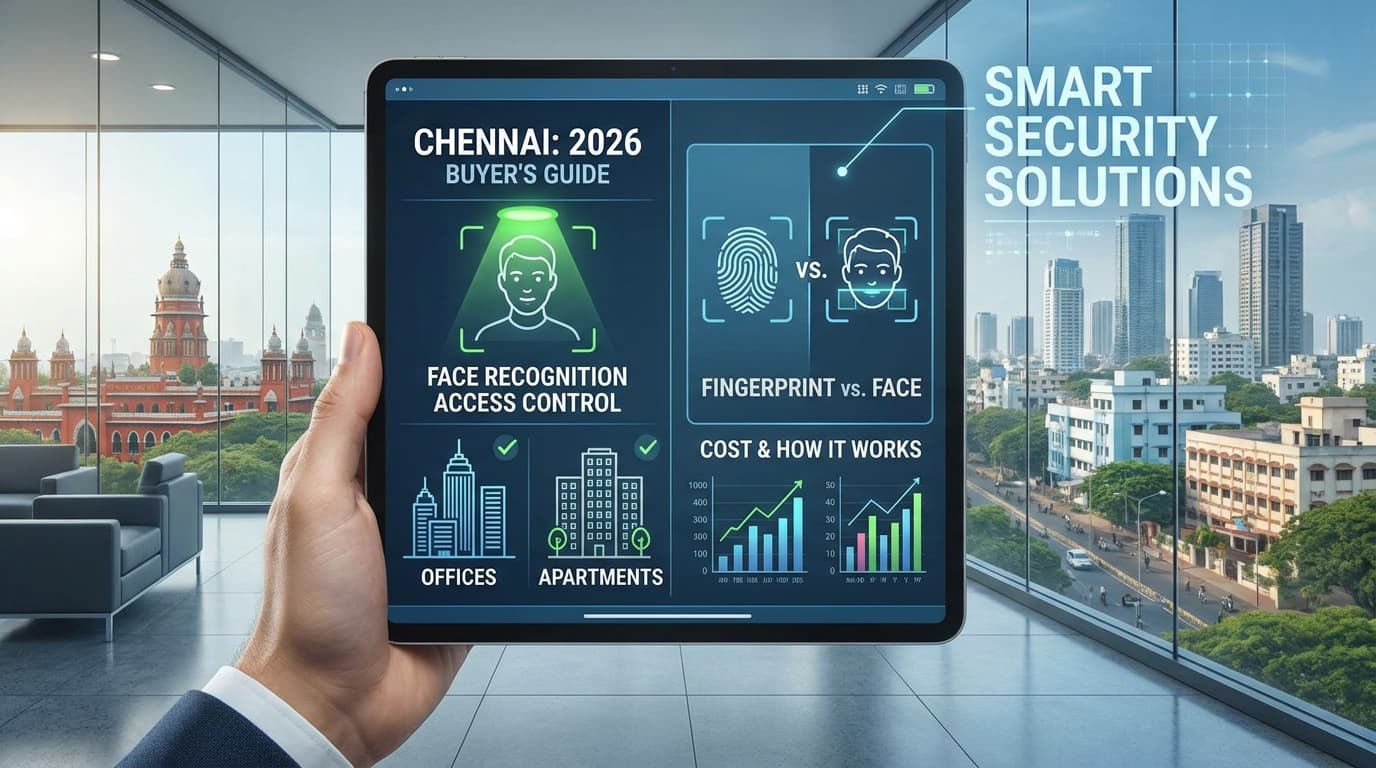
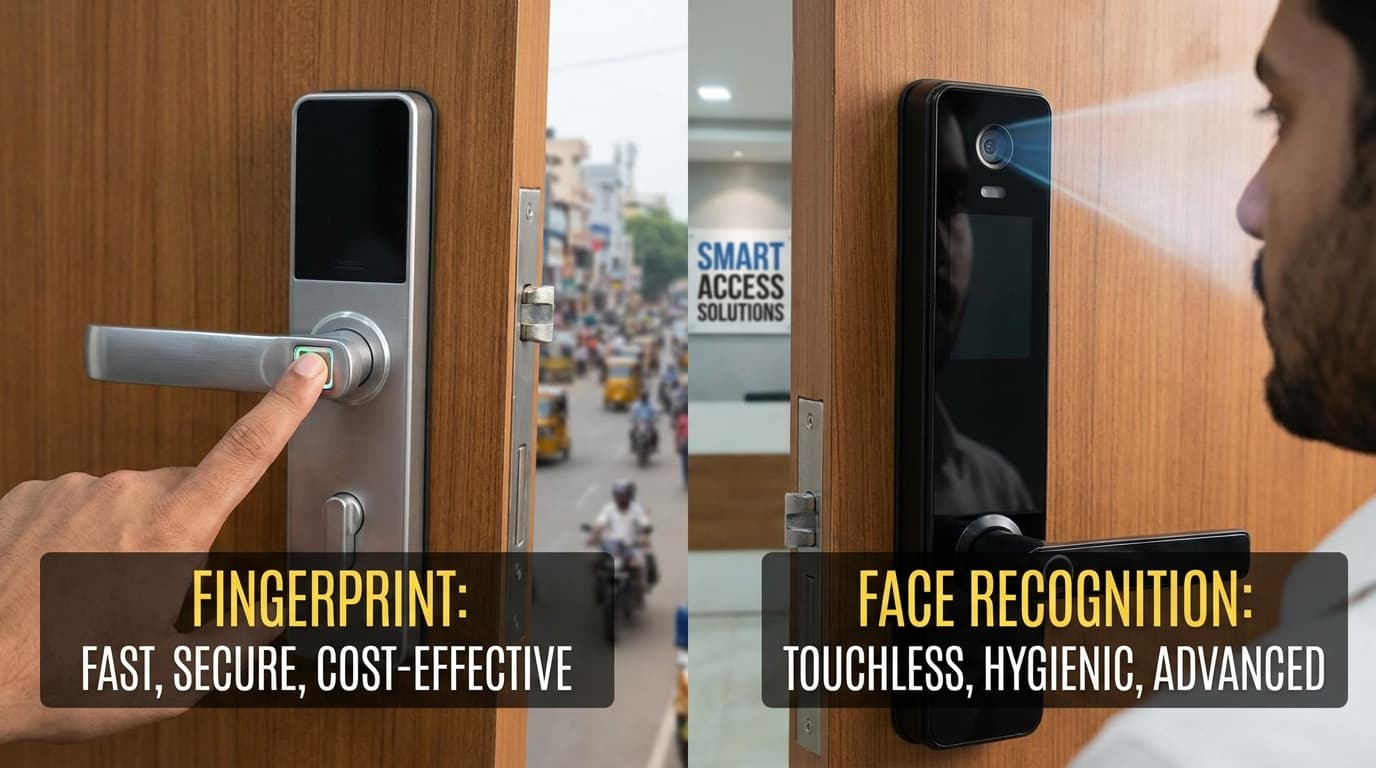
Both fingerprint and face recognition door locks kill the weak points of keys and cards — lost copies, shared PINs, cloned RFID tags. But they are not interchangeable. The right pick depends on your environment, how many people use the door, your hygiene priorities, and your budget. A lock that's perfect for a quiet two-bedroom flat in Adyar can be the wrong call for a 200-worker factory in Ambattur.
This biometric door lock comparison puts fingerprint vs face recognition head-to-head — on speed, accuracy, spoofing, hygiene, cost, and real Chennai conditions — so homes, offices, and housing societies can choose the system that actually fits the premises.
Quick take: Face recognition wins for speed, hygiene, and busy or industrial entrances. Fingerprint wins for tight budgets and small, controlled doors. For larger sites, the best answer is usually both.
How Each Technology Works
A fingerprint door lock scans the ridge pattern of a finger, converts it to an encrypted template (not a stored image), and unlocks when a live scan matches. The user must physically touch the sensor. Optical sensors photograph the print; capacitive and ultrasonic sensors read it electrically and resist fakes better.
A face recognition door lock uses a camera to map facial geometry into a template and matches it as the person approaches — no contact required. Quality units add infrared (IR) cameras and 3D depth sensing for low light and anti-spoofing. Cheaper 2D-only units can be fooled by a printed photo, which is the single most important spec to check.
Both are forms of biometric access control, and both can log attendance automatically for payroll — a major reason businesses switch from punch cards. If you're also weighing RFID cards or PIN entry, see our wider fingerprint vs face vs RFID vs card comparison; and before rolling out biometric attendance for staff, check whether biometric attendance is legal in India under the DPDP Act.
Head-to-Head Comparison
| Factor | Fingerprint Door Lock | Face Recognition Door Lock |
|---|---|---|
| Contact | Touch required | Fully contactless |
| Recognition speed | Fast (~0.3–0.5s, must stop) | Fastest (~0.2–0.4s, walk-through) |
| Accuracy (FRR) | High; fails on bad fingers | High with 3D/IR; lower on 2D units |
| Hygiene | Shared touch surface | Touchless |
| Spoof resistance | High (capacitive/ultrasonic) | Very high with liveness; weak on 2D |
| Wet / dirty / cut fingers | Often fails | Unaffected |
| Masks & coverings | Works fine | Struggles with full masks |
| Low light | Unaffected | Needs IR camera to work |
| Cost per door | Low–medium | Medium–higher |
| Best for | Homes, small offices, labs | Lobbies, factories, society gates |
Speed and Convenience
Face recognition is the faster real-world experience. People walk toward the door and it unlocks as they arrive — ideal for busy entrances where queues form during shift changes or peak office hours. No stopping, no positioning, no touching.
Fingerprint requires each person to stop and place a finger correctly on the sensor. For a small team or a low-traffic home door, that friction is negligible. For a 150-person office at 9 AM or a factory gate at shift change, those seconds stack into a bottleneck — and frustrated staff who prop the door open, defeating the whole system.
Accuracy in Real Chennai Conditions
This is where most decisions are actually made, and where lab specs meet monsoon reality:
- Wet, dusty, cut, or worn fingers — common on construction sites, in kitchens, factories, and any labour-heavy workplace — frequently fail on fingerprint sensors. Chennai's humid, sweaty climate makes this worse. Face recognition is completely unaffected, which is why industrial and warehouse sites lean toward face.
- Masks and head coverings — fingerprint works fine; helmets, full veils, or masks may force a face system to fall back to a card or PIN.
- Bright glare and dim corridors — quality face locks with IR cameras handle Chennai's harsh afternoon sun and unlit stairwells; budget 2D cameras struggle in both extremes.
- Power cuts — neither system unlocks without backup power. Every install needs a UPS or battery and a fail-safe (unlock on power loss) or fail-secure plan decided up front. This alone is a strong reason to insist on professional installation and an annual maintenance contract.
In measured terms, both technologies sit around 99% accuracy in ideal conditions. The gap opens in non-ideal conditions — and in a hot, dusty, high-humidity city, those conditions are most of the year.
Security and Anti-Spoofing
Both biometrics are far harder to defeat than physical keys or shared RFID cards, which can be lost, copied, or handed around. The deciding quality factor is anti-spoofing:
- Fingerprint — optical sensors are the most spoofable (lifted prints, silicone molds). Capacitive and ultrasonic sensors detect properties of living skin and resist fakes well. Some premium units add pulse or sub-dermal detection. Specify the sensor type; don't buy on price alone.
- Face recognition — must include liveness detection: 3D depth mapping, IR analysis, or motion checks so it cannot be unlocked with a printed photo or a phone screen. A 2D-only face lock is a genuine security risk. Never buy a face lock without certified liveness.
Beyond the lock itself, the templates should be encrypted and stored on-device, and the system should keep an audit log of every entry. For multi-tenant buildings especially, that audit trail matters — see how this plays out in our guide to access control for apartments and housing societies.
Cost Comparison
Fingerprint locks are generally the lower entry point per door, which makes them attractive for single-door homes and small offices. Face recognition terminals cost more upfront but deliver faster throughput, contactless hygiene, and stronger attendance features that often justify the difference for offices, factories, and society lobbies.
Hardware is only part of the bill, though. The real cost of a working system also includes the lock mechanism (EM lock or electric strike), door cabling, controller and configuration, and ongoing AMC support. A cheap terminal bolted onto a poorly wired door fails fast and costs more over two years than a properly installed mid-range unit. We give transparent quotes only after a free site survey — no invented numbers, no surprises.
When to Choose Which, by Use Case
Homes — a fingerprint lock is usually ideal: one or a few doors, a small known set of users with clean hands, and budget sensitivity. Step up to face recognition for premium villas or homes with elderly residents who find sensors fiddly, where hands-free entry is genuinely more convenient.
Offices — it depends on headcount. Small teams do fine with fingerprint plus attendance logging. Larger offices with morning rush hours benefit from face recognition at the main entrance for walk-through speed and clean payroll data, with fingerprint or cards on internal doors.
Factories and warehouses — face recognition almost always wins. Workers with dirty, wet, or worn fingers defeat fingerprint sensors daily, and IR cameras handle dust and variable light. Contactless entry also keeps lines moving at shift change.
Housing societies and apartments — face recognition at the main gate and lobby gives residents fast, hands-free entry and gives the management committee a clean visitor and resident log. This pairs naturally with face recognition access control at perimeter points.
The Smart Answer: Hybrid Multi-Factor
For anything larger than a single home door, the strongest setup is rarely "either/or." A hybrid multi-factor system uses face recognition at the busy main entrance, fingerprint or RFID cards as backup credentials on specific doors, and PIN as a fallback when biometrics fail — all managed from one controller with a single audit log.
This removes the single point of failure: if a worker's hands are too dirty for the sensor, the face camera covers them; if someone's at an awkward angle for the camera, a fingerprint or card lets them in. For high-security doors, you can require two factors together. That's the configuration we most often recommend for Chennai offices and societies.
Our Recommendation
There is no universal winner in the fingerprint vs face recognition debate — there is only the right fit for your door, your traffic, and your environment. Fingerprint is the budget-friendly, reliable choice for small, clean-handed teams and home doors. Face recognition is the faster, hygienic, more resilient choice for busy, industrial, or shared entrances — provided it has proper liveness detection. For larger premises, combine both.
WAEI Enterprise designs and installs both technologies, plus integrated CCTV, across Chennai — backed by 1 year of free AMC and transparent, survey-based quotes. Book a free site survey and we'll recommend the right biometric door lock for your premises.
Frequently Asked Questions
Is face recognition more secure than fingerprint?
With proper liveness detection, face recognition is extremely hard to spoof and edges out fingerprint for busy entrances. But a cheap 2D-only face lock with no liveness is actually less secure than a quality capacitive fingerprint lock. The technology label matters less than the spec: insist on liveness for face, and capacitive or ultrasonic sensors for fingerprint. Both are far more secure than keys or shared cards.
Which is better for a factory or warehouse in Chennai?
Face recognition, in almost every case. Workers frequently have dirty, wet, sweaty, or worn fingers that cause fingerprint scanners to fail repeatedly, and Chennai's humidity makes this worse. Infrared face cameras also handle dust and low light, and contactless entry keeps shift-change queues moving.
Is a fingerprint lock good enough for a home?
Yes. For a single residential door with a small, known set of users who have clean, intact fingers, a fingerprint lock is reliable, affordable, and easy to manage. Consider face recognition only if you want hands-free convenience or have elderly residents who find sensors fiddly.
Can I use both fingerprint and face on the same system?
Yes, and for larger sites you usually should. Hybrid multi-factor setups are common: face recognition at the main door, fingerprint or RFID cards as backup on other doors, and a PIN fallback, all managed centrally with one audit log. High-security doors can require two factors together.
Do biometric door locks work during a power cut?
Only if installed with backup power, such as a UPS or battery, and a planned fail-safe or fail-secure lock configuration. No biometric lock unlocks on its own during an outage, which is exactly why professional installation and an AMC matter in a city with frequent power fluctuations.
How much does a biometric door lock cost in Chennai?
It depends on the lock type, the number of doors, the lock mechanism, cabling, and the controller — so a fixed figure would be misleading. Fingerprint units are the lower entry point; face recognition terminals cost more but add speed and attendance features. WAEI gives a transparent quote after a free site survey rather than a guessed price.
Last updated: June 2026. Specifications subject to change.
Tags
- Fingerprint vs Face Recognition
- Biometric Access Control Chennai
- Biometric Door Lock
- Fingerprint Door Lock Chennai
- Face Recognition Access Control
- Access Control Systems Chennai