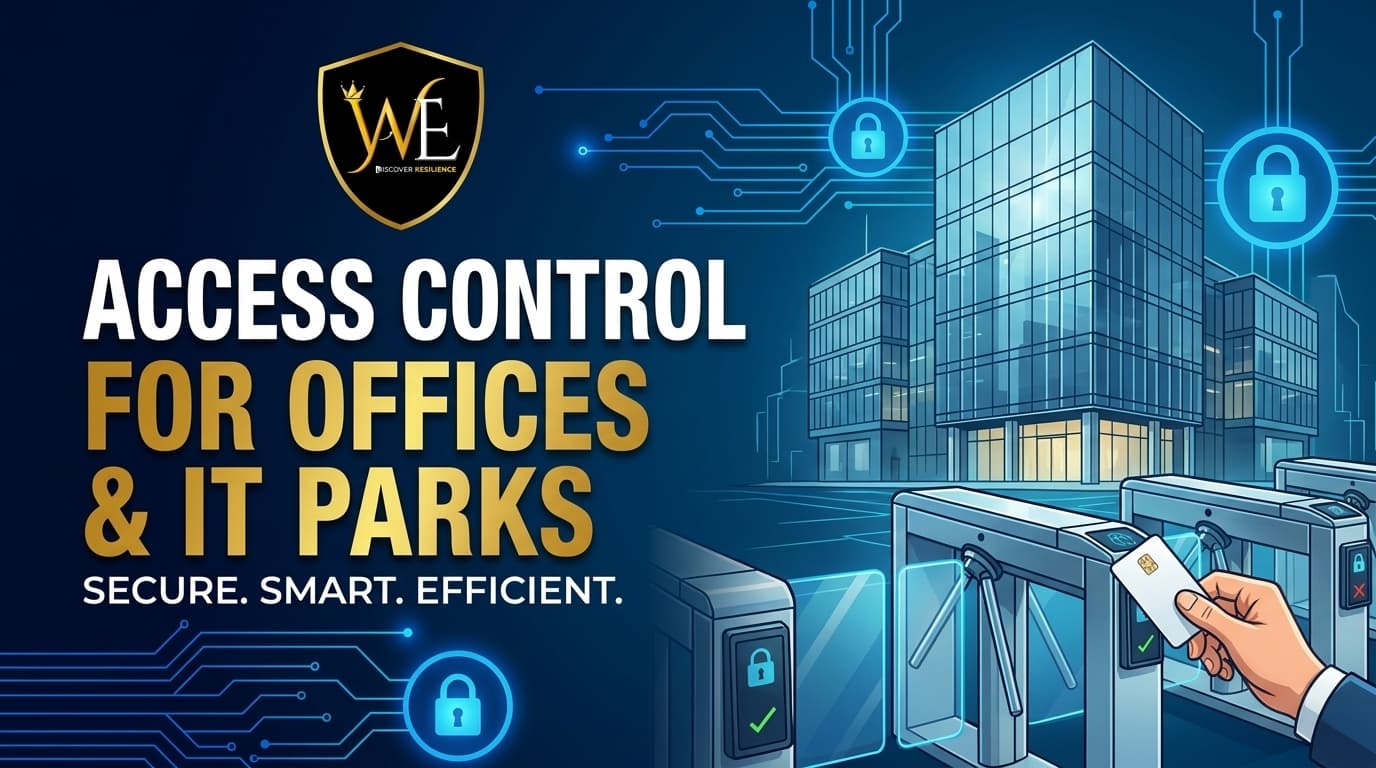
An office door that anyone can hold open for the person behind them isn't controlled — it's just a door. For corporate offices and IT parks across Chennai — the OMR tech corridor, Guindy, Ambattur, Nungambakkam, and Taramani's SEZs — access control is what separates a professional, auditable workplace from one relying on a receptionist's memory and a sign-in book. It decides who reaches which floor, logs every employee's hours for payroll, verifies every visitor, and stops the tailgater who walks in behind a genuine badge.
This guide is written for facility managers, admin heads, and HR teams. It covers the multi-entry reality of an office building, the tailgating problem that defines corporate security, floor and lift access in multi-tenant towers, attendance that feeds payroll cleanly, and the visitor and compliance details that a generic dealer page won't tell you.
Quick take: A corporate setup pairs anti-tailgating turnstiles or speed gates at reception with face or card + mobile credentials, floor- and lift-level access so employees reach only their zones, attendance that exports to your HRMS, and a QR-code visitor system that notifies the host — all on one audited dashboard.
The Multi-Entry Reality of an Office Building
An office is rarely one entrance. A typical Chennai IT-park building or corporate floor has several flows that each need distinct rules, managed from one access control system:
- Main employee entry — the high-traffic reception or lobby where throughput and tailgating control matter most.
- Visitor reception — guests, interview candidates, and clients, verified and hosted.
- Delivery / vendor gate — couriers, pantry, and facility vendors, kept separate from employee flow.
- Internal zones — server rooms, finance, HR, R&D, and executive cabins, restricted to authorised staff.
- Lifts and floors — in multi-tenant towers, controlling which floors a credential can reach.
- Parking and basement — vehicle access and the basement pedestrian exit.
The goal is a single record of who moved through which point, at what time — the audit trail corporate security and client compliance both demand.
Tailgating: The Corporate Security Problem
Tailgating — an unauthorised person slipping in behind someone with valid access — is the single most common security failure at Chennai tech campuses, and a card reader alone does nothing to stop it. The fixes are physical and procedural:
- Turnstiles or speed gates at reception physically allow one authenticated person per entry, ending the "hold the door" habit at the busiest point.
- Anti-passback rules prevent one credential being used to enter twice in a row without an exit in between — stopping badge-sharing.
- Mantrap / interlocked doors for high-security areas like data centres, where one door must close before the next opens.
- CCTV at every controlled door so tailgating attempts are recorded and reviewable.
For client audits (ISO, SOC 2, ODC requirements common in Chennai's IT sector), demonstrable anti-tailgating control is often a contractual necessity, not a nicety.
Choosing the Right Credential for an Office
Offices favour a mix, tuned to speed and professionalism:
- Face recognition at reception — fast, hands-free, hygienic, and doubles as attendance; ideal for the morning rush.
- RFID / smart cards — the corporate default for internal doors and visitor/contractor issuing; pair with encrypted smart cards (MIFARE DESFire), not basic proximity cards.
- Mobile / Bluetooth (BLE) access — increasingly expected in modern offices, letting employees use their phone as a credential; worth asking about for a new fit-out.
- PIN as a backup only.
For the full trade-off, see our fingerprint vs face vs RFID vs card comparison and face recognition access control guide. Fingerprint is the weakest fit for a high-traffic corporate lobby — slower and a shared touch surface — though it's fine on low-traffic internal doors.
Floor & Lift Access in Multi-Tenant Towers
In a shared IT-park tower, you don't want every badge reaching every floor. Lift access control restricts the elevator so a credential only calls or selects the floors it's authorised for, and floor-lobby readers gate entry off the lift. This is essential where multiple companies share a building and each tenant's employees, visitors, and contractors must stay in their own space. It pairs naturally with our lift access and camera solutions. Executive floors, finance, and server rooms get an extra zone layer on top.
Employee Attendance That Feeds Payroll
For HR, the same readers that secure the office produce clean attendance:
- Automatic in/out logging at the main entry replaces manual registers and eliminates buddy-punching.
- HRMS / payroll export to greytHR, Zoho, Darwinbox, or an Excel format, so hours are calculated on verified data — confirm the export format before you buy (see our guide to connecting biometric attendance to payroll and HRMS).
- Shift and flexi-time handling for teams that don't run 9-to-5, including the three-shift tech campuses common on OMR.
- Work-from-office reporting — accurate on-site day counts, increasingly needed for hybrid-work policies.
This turns attendance from an HR chore into a by-product of walking through the door.
Visitor Management for a Corporate Reception
A professional visitor experience is also a security control:
- Pre-registration and QR e-passes — hosts pre-invite guests who arrive with a QR code for quick, verified check-in.
- Host notification — the employee is alerted the moment their visitor arrives at reception.
- Photo, ID, and purpose capture — every visitor logged with a badge, timestamp, and the person they're meeting.
- NDA / policy acceptance — visitors can acknowledge confidentiality or safety terms at check-in, useful for IT and R&D environments.
- Watchlist and blocklist — flag unwanted visitors automatically.
It replaces the register with a record that looks professional to clients and stands up in an audit.
Handling Three-Shift Tech Campuses
Chennai's IT sector runs around the clock, and the hardest window is the late-night handover between roughly 10 PM and 2 AM, when late developers and early operations staff overlap. A proper system handles it with shift-aware access rules, time-bound permissions, well-lit CCTV-covered entries for odd-hour safety, and accurate attendance across shift boundaries — so security never depends on which guard happens to be on duty.
Integration: CCTV, Lift & Fire Safety
Access control is strongest tied into the wider building:
- CCTV — linking access logs to footage at every controlled door gives a complete incident record and catches tailgating.
- Lift integration — as above, floor-level control in multi-tenant towers.
- Fire alarm — on a fire trigger, controlled doors fail-safe (release) so no one is trapped, while the system's last-known-inside data aids evacuation roll-call.
- One dashboard — facilities runs day-to-day; management pulls audit trails and reports centrally.
Every WAEI installation is backed by 1 year of free AMC, because a stuck office turnstile at 9 AM is a business problem, not just a security one.
Compliance: Employee Data Under the DPDP Act
When you enrol employees' faces or fingerprints, those templates are personal data under India's DPDP Act. The reassuring part for employers: workplace attendance and security qualify as a recognised employment "legitimate use," so a compliant rollout is straightforward — store encrypted templates (not raw images), be transparent with staff, and delete the data when someone leaves. The full framework is in our guide to whether biometric attendance is legal in India under the DPDP Act. For staff who prefer not to enrol a biometric, cards or mobile credentials are the alternative. We configure office systems for local encrypted storage and clean retention by default.
Frequently Asked Questions
What is the best access control system for an office in Chennai?
A layered corporate setup: anti-tailgating turnstiles or speed gates with face or card credentials at reception, RFID smart cards or mobile access on internal doors, floor and lift access control in multi-tenant towers, attendance that exports to your HRMS, and a QR-code visitor system with host notifications — all on one audited dashboard. The exact mix depends on your building and headcount.
How do you stop tailgating in an office?
Tailgating is stopped physically and procedurally: turnstiles or speed gates allow one authenticated person per entry, anti-passback prevents a badge being reused without an exit, mantrap doors protect high-security areas like server rooms, and CCTV at every controlled door records attempts. A card reader alone cannot prevent tailgating, which is why physical gating matters for corporate audits.
Can access control manage floor and lift access in a multi-tenant IT park?
Yes. Lift access control restricts which floors a credential can reach, and floor-lobby readers gate entry off the lift, keeping each tenant's employees, visitors, and contractors in their own space. Executive floors, finance, and server rooms can be given an additional zone layer.
Does office access control integrate with payroll and HRMS?
Yes. The same readers that secure the office log employee in/out times automatically and export to HRMS or payroll software such as greytHR, Zoho, or Darwinbox, so hours are calculated on verified data with no buddy-punching. Confirm the export format matches your HRMS before purchase.
How does the visitor management system work in a corporate office?
Hosts pre-register guests who arrive with a QR e-pass for quick check-in, the host is notified the moment the visitor arrives, and every visitor is logged with a photo, ID, purpose, and badge. Visitors can accept an NDA or safety policy at check-in, and watchlists can flag unwanted callers — a professional record that also satisfies client audits.
Is employee biometric attendance in an office legal under the DPDP Act?
Yes. Workplace attendance and security qualify as an employment "legitimate use" under the DPDP Act, so it's legal provided you store encrypted templates securely, are transparent with employees, and delete the data when they leave. Staff who prefer not to enrol a biometric can use cards or mobile credentials instead.
Conclusion
A professional office needs more than a locked door — it needs a system where employees flow in without tailgaters, each person reaches only their authorised floors and zones, attendance feeds payroll automatically, and every visitor is verified and hosted. Turnstiles, face or card plus mobile credentials, lift and floor control, HRMS-linked attendance, and QR visitor passes turn a Chennai office into an auditable, client-ready workplace.
At WAEI Enterprise, we design and install office and IT-park access control, turnstiles, visitor management, and integrated CCTV and lift access across Chennai — brand-neutral, DPDP-aligned, and backed by 1 year of free AMC. Book a free site survey and we'll map the right setup for your office or campus.
Last updated: July 2026. Specifications and pricing subject to change.
Tags
- Access Control for Office
- Office Access Control Chennai
- IT Park Security Chennai
- Access Control Systems Chennai
- Employee Attendance System
- Visitor Management System Chennai