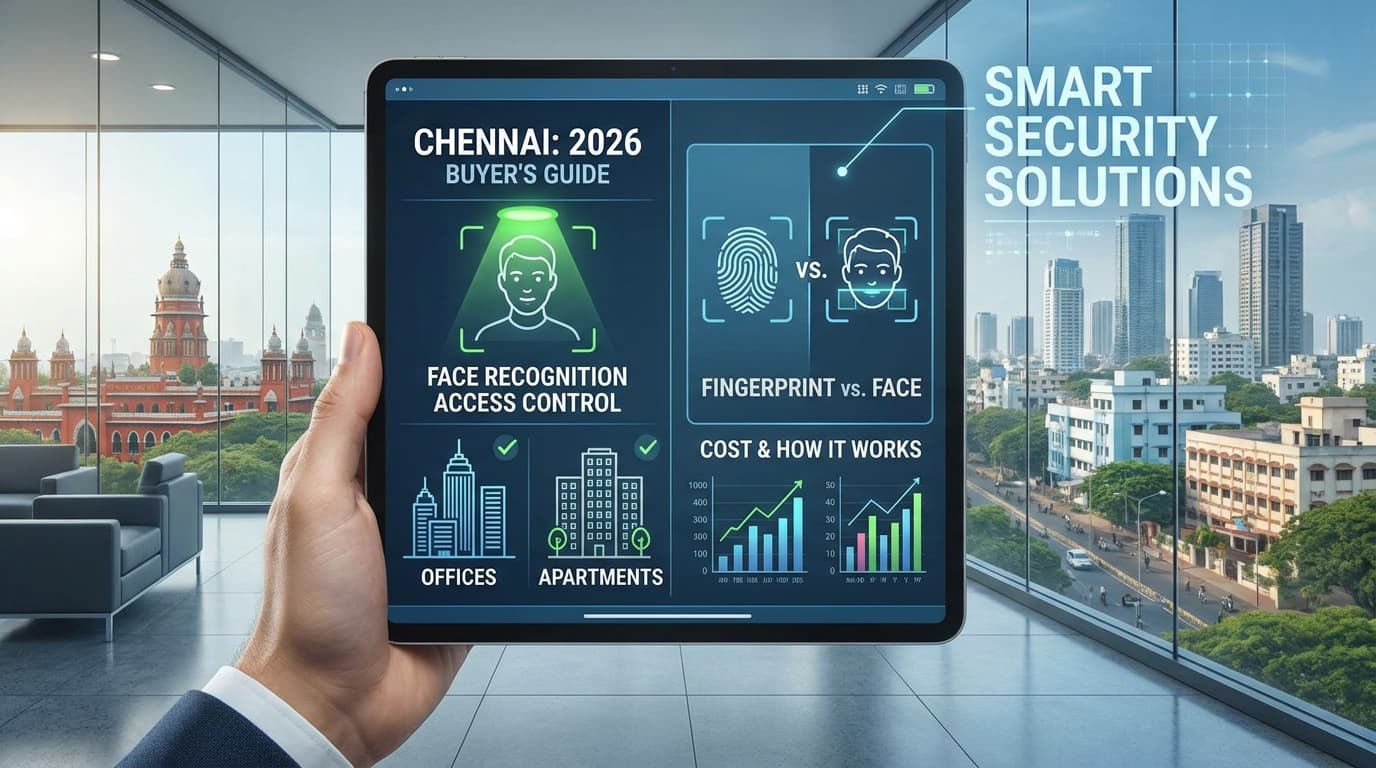
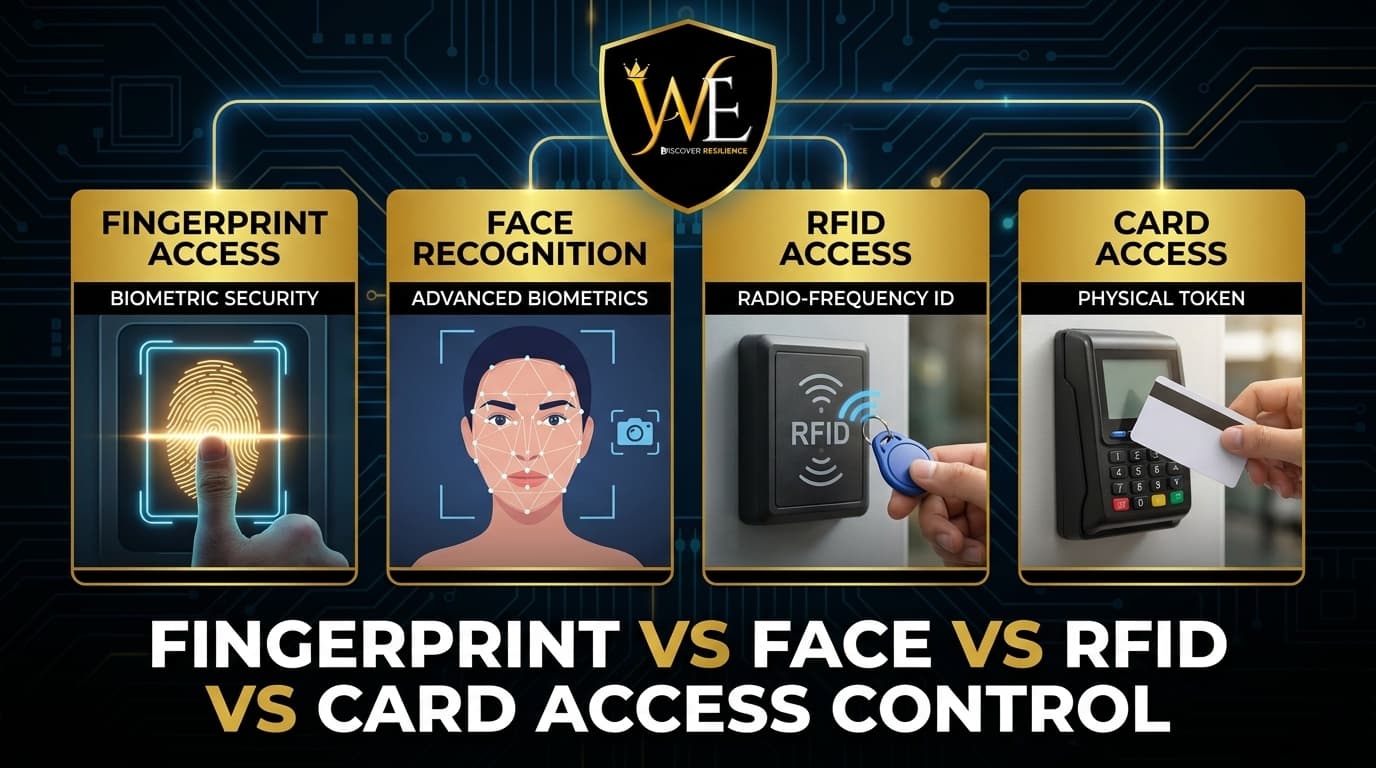
Every access control system comes down to one question: what does a person present at the door to prove they belong there? That credential can be a fingerprint, a face, an RFID card or tag, a mobile phone, or a PIN — and the one you choose shapes your system's security, speed, running cost, and day-to-day hassle more than any other decision.
There is no single "best" credential. A fingerprint reader that's perfect for a quiet 12-person office in T. Nagar can be the wrong call for a 300-worker factory in Ambattur or a 200-flat gated community in OMR. This guide compares fingerprint vs face vs RFID vs card access control — brand-neutral, on the factors that actually matter — so Chennai offices, factories, and apartments can pick the credential that fits the premises, not the one a single-brand dealer happens to stock.
Quick take: RFID/cards are cheapest and fastest to issue but easiest to share or clone. Fingerprint is secure and affordable but struggles with wet or worn hands. Face recognition is fast, hygienic, and hard to fake — at a higher price. For most sites larger than a single door, the right answer is a hybrid that combines two of them.
The Four Credential Types at a Glance
An access control credential is simply the "key" a person uses. Each maps to a different balance of security, convenience, and cost:
- Fingerprint — the person touches a sensor that reads their ridge pattern. A something you are credential: it cannot be lent out, but it depends on the physical condition of the finger.
- Face recognition — a camera matches facial geometry as the person approaches. Contactless and fast, and doubles neatly as an attendance device.
- RFID card / tag / fob — a chip is held near a reader. A something you have credential: quick and cheap to issue in bulk, but only as secure as the card is hard to copy or share.
- PIN / password — a code typed on a keypad. A something you know credential, usually a low-cost backup rather than a primary method.
A fifth option — mobile / Bluetooth (BLE) access, where a phone becomes the credential — is growing fast for modern offices and is worth asking about, but the four above are what most Chennai premises choose between today. All of them are configured within a single access control system: reader, door controller, lock, exit button, and power backup working together (see how an access control system works).
The Master Comparison
This is the head-to-head competitors rarely lay out honestly — because most are locked to one brand or one technology:
| Factor | Fingerprint | Face Recognition | RFID Card / Tag | PIN Code |
|---|---|---|---|---|
| Credential type | Something you are | Something you are | Something you have | Something you know |
| Speed | Fast (must touch) | Fastest (walk-through) | Fast (tap) | Slowest (type) |
| Contactless | No | Yes | Yes | No (shared keypad) |
| Hard to share/fake | High | Very high (with liveness) | Low — cards get shared, cloned | Very low — codes get told |
| Cost per door | Low–medium | Medium–higher | Lowest | Lowest |
| Bulk issuing (visitors, contractors) | Poor (must enrol each) | Poor (must enrol each) | Excellent | Excellent |
| Copes with dirty/wet hands | Often fails | Yes | Yes | Yes |
| Works in low light / glare | Yes | Needs IR camera | Yes | Yes |
| Doubles as attendance | Yes | Yes (best) | Yes | Weak |
| Lost-credential risk | None to lose | None to lose | Card lost/stolen | Code forgotten/leaked |
The pattern is clear: biometrics win on security, cards win on cost and bulk issuing, and face recognition wins on speed and hygiene. No column is best at everything — which is exactly why the "right" choice depends on your door, your headcount, and your environment.
Security: What Actually Defeats Each One
Every credential fails in a different way. Knowing how is how you avoid buying the wrong one:
- RFID cards and tags are the weakest link on security. Cards get lost, stolen, shared, or cloned, and low-frequency proximity cards are vulnerable to relay and signal-replay attacks. Encrypted smart cards (MIFARE DESFire and similar) are far safer than basic 125 kHz EM cards — if a dealer quotes RFID, ask which. A card only proves someone has the card, not that they are who they should be.
- PINs share the same flaw as passwords: they get told to colleagues, written on desks, and reused. Fine as a fallback, weak as a primary door credential.
- Fingerprint cannot be shared or handed over, which already beats cards. Its weak point is spoofing: cheap optical sensors can be fooled by lifted prints or moulds, while capacitive and ultrasonic sensors detect properties of living skin and resist fakes well. Specify the sensor type.
- Face recognition is the hardest to defeat — provided it has genuine liveness detection (3D depth, infrared, or motion analysis) so it cannot be unlocked with a printed photo or a phone screen. A cheap 2D-only face terminal without liveness is a real security risk and can actually be less safe than a good fingerprint reader. Never buy a face system without certified liveness.
There's also a data-protection dimension unique to biometrics: because a fingerprint or face template is personal data, how you store and delete it is now regulated. If you're deploying biometric attendance for staff, read our guide on whether biometric attendance is legal in India under the DPDP Act before you roll it out — cards and PINs don't carry that obligation, which is one quiet reason some organisations keep RFID for general staff and reserve biometrics for sensitive doors.
Speed and Convenience
For a busy entrance, throughput matters as much as security. Face recognition is the fastest real-world experience — people walk toward the door and it unlocks as they arrive, no stopping or touching, which clears shift-change and 9 AM office rushes without queues. RFID is nearly as quick with a simple tap. Fingerprint requires each person to stop and place a finger correctly. PIN is slowest and creates the worst bottleneck.
Where credentials must be issued in bulk and fast — visitors, contractors, delivery staff, a rotating warehouse workforce — RFID wins decisively. You hand over a pre-programmed card in seconds; you don't enrol a biometric for a one-day contractor. This bulk-issuing advantage is the single strongest reason cards remain everywhere despite their security weaknesses.
Cost: The Honest Picture
RFID is the lowest entry cost — inexpensive readers and cheap cards make it attractive for large or high-turnover user bases. Fingerprint sits in the low-to-medium band per door. Face recognition terminals cost the most upfront but return that in throughput, hygiene, and strong attendance features.
But per-door hardware is only part of the bill. The real cost of a working system also includes the lock mechanism (EM lock or electric strike), door cabling, the controller and configuration, power backup, and ongoing AMC support. A cheap terminal bolted onto a poorly wired door fails fast and costs more over two years than a properly installed mid-range unit. India's access control market is growing quickly for exactly this reason — organisations are moving from keys and registers to managed systems — but the savings come from buying the right configuration once, not the cheapest box. We quote transparently only after a free site survey, never an invented number over the phone.
Best Credential by Property Type
Offices & IT parks — mixed is usually best. Face recognition at the main entrance for walk-through speed and clean attendance data; RFID cards for visitors and contractors; fingerprint or PIN on internal doors. Small teams can start with fingerprint alone — see our fingerprint attendance machine buyer's guide for how to spec one.
Factories & warehouses — face recognition almost always wins for workers, because dirty, wet, cut, or worn fingers defeat fingerprint sensors daily and Chennai's humidity makes it worse; IR cameras cope with dust and low light. Pair it with RFID for the constant flow of contractors and delivery staff.
Apartments & gated communities — face recognition at the gate and lobby gives residents fast, hands-free entry and the committee a clean resident and visitor log, with RFID cards or fobs for visitors and service staff. See our face recognition access control buyer's guide for the community setup.
Retail, clinics & schools — RFID cards for staff are cheap and simple, with biometrics reserved for stockrooms, pharmacies, or restricted zones that genuinely need higher assurance. For campuses specifically, see biometric attendance for schools and colleges in Chennai.
For a deeper biometric-only decision — fingerprint against face for a specific door — see our focused fingerprint vs face recognition door lock comparison.
The Smart Answer: Hybrid Multi-Factor
For anything larger than a single door, the strongest setup is rarely "either/or." A hybrid system plays each credential to its strength: face recognition at the busy main entrance, RFID cards for visitors and contractors, fingerprint or PIN as a backup on specific doors — all managed from one controller with a single audit log.
This removes the single point of failure. If a worker's hands are too dirty for the sensor, the face camera covers them; if a visitor has no enrolled biometric, a card lets them in. And for genuinely high-security doors — server rooms, cash rooms, labs — you can require two factors together (card and fingerprint), which is far stronger than any single credential. This layered configuration is what we most often design for Chennai offices, factories, and societies.
Frequently Asked Questions
Which is more secure: RFID card or biometric access control?
Biometric access control (fingerprint or face) is more secure than RFID cards for most purposes, because a card can be lost, shared, stolen, or cloned, whereas a biometric is tied to the individual. Encrypted smart cards (like MIFARE DESFire) narrow the gap, but for sensitive doors biometrics with proper anti-spoofing are the stronger choice. Many sites use RFID for general staff and biometrics for restricted areas.
What is the cheapest access control credential?
RFID cards and tags are the cheapest, with low-cost readers and inexpensive cards, which is why they suit large or high-turnover user bases. PIN keypads are similarly low-cost. Fingerprint is mid-range and face recognition is the most expensive per door, though it adds speed, hygiene, and attendance features that often justify the cost.
Which access control is best for a factory in Chennai?
Face recognition for the workforce, usually paired with RFID for contractors and visitors. Factory workers frequently have dirty, wet, sweaty, or worn fingers that cause fingerprint scanners to fail, and Chennai's humidity worsens this. Infrared face cameras handle dust and low light, and contactless walk-through entry keeps shift-change queues moving.
Can I use cards and biometrics on the same system?
Yes. Most modern access control systems support multiple credential types on one controller with a single audit log. A common setup is face recognition at the main entrance, RFID cards for visitors, and fingerprint or PIN on internal doors, with two-factor (card plus biometric) required on high-security doors.
Are RFID cards easy to clone?
Basic low-frequency proximity cards (125 kHz EM) can be cloned relatively easily and are vulnerable to relay attacks. Encrypted high-frequency smart cards such as MIFARE DESFire are far harder to copy. If you choose RFID, always ask which card technology the dealer is quoting — the security difference is significant.
Do biometric systems raise data-privacy obligations that cards don't?
Yes. A fingerprint or face template is personal data under India's DPDP Act, so you must store it securely, use it only for the stated purpose, and delete it when no longer needed. RFID cards and PINs don't carry the same biometric-data obligations, which is one reason some organisations limit biometrics to sensitive doors.
Conclusion
There is no universal winner between fingerprint, face, RFID, and card access control — only the right fit for your door, your traffic, and your environment. RFID and PINs are cheap and easy to issue in bulk but weak on security. Fingerprint is secure and affordable but sensitive to hand condition. Face recognition is the fastest, most hygienic, and hardest to fake, at a higher price and with data-protection duties. For most premises, a hybrid that combines the right two beats any single credential.
At WAEI Enterprise, we're brand-neutral by design — we install fingerprint, face, RFID, card, and hybrid multi-factor access control systems across Chennai, backed by 1 year of free AMC and transparent, survey-based quotes. Book a free site survey and we'll recommend the credential mix that actually fits your premises.
Last updated: July 2026. Specifications and pricing subject to change.
Tags
- Access Control Credentials
- RFID vs Biometric Access Control
- Access Control Systems Chennai
- Fingerprint vs Face vs RFID
- Card Access System Chennai
- Door Access Control Chennai